This is service-process guidance only. Confirm the specific start point and filing method before proceeding; bank-account opening, tax and specialist licences are arranged separately. View processing time and steps ↓
Materials preparation
Registration coordination
Progress follow-up
File delivery
02 / DOCUMENT CHECKLIST
What materials are needed for registration.
Prepare company and personal materials first; check document-route and address-evidence requirements before submission.
01 / DOCUMENT
Company name
Provide the proposed company name.
Confirm the entity and filing route02 / DOCUMENT
Director and shareholder identity documents
Prepare identity-card and passport scans, confirming the actual submission set under the applicant's document route.
Confirm the entity and filing route03 / DOCUMENT
Proof of address
A route that does not provide a passport requires an identity card and proof of address; the specific accepted method is confirmed before processing.
Confirm the entity and filing route04 / DOCUMENT
Registered capital
Confirm the proposed registered capital.
Confirm the entity and filing route05 / DOCUMENT
Shareholding ratio
List shareholders and their respective ownership percentages.
Confirm the entity and filing route06 / DOCUMENT
Business scope
Describe the business the company intends to conduct and its purpose.
Confirm the entity and filing route
The above is a preliminary document checklist for registration services. Submit only after the entity and processing route are confirmed; supplementary documents will be notified according to actual review requirements. This page does not collect or store identity documents.
03 / BEFORE YOU START
Before submitting, first Explain the basic situation clearly.
Explain the business purpose, applicant and operating arrangements, and we will confirm the required materials and service scope.
Prepare company and personal materials first; check document-route and address-evidence requirements before submission.
04 Notes before submission
Applicable companies must maintain information and report it to the government's central platform.
04 / PROCESS & TIMELINE
After materials are confirmed, Arrange the handling step by step.
About 25
working days
Cayman Islands company formation is referenced at about 25 working days. Check shareholder and director documents, share capital and business arrangements before preparing the incorporation documents.
01
Choose the company type
Confirm the business location, member responsibilities, governance and regulatory purpose.
02
Reserve the company name
Check and reserve the name through the official portal or a service provider.
03
Prepare organisational documents
Prepare the Memorandum, Articles, and director or member consent documents.
04
Submit the incorporation application.
Submit through the Cayman Business Portal or a licensed service provider.
05
Address post-formation obligations
Maintain the registered office, annual filings, beneficial ownership, Economic Substance, and applicable licences.
Progress is affected by the completeness of materials, name confirmation, identity verification, and supplemental documents. Electronic documents and mailed paper documents are arranged separately. This is a service-handling reference only; the starting point for timing and filing method are confirmed before work begins. Bank-account opening, tax, and specialist licences are arranged separately. View delivery files ↓
REGISTRATION DOCUMENTS / Delivered after completion
What will you receive after incorporation.
Deliver the following company documents, seals and document box under the confirmed plan.
01
Formation and appointment documents
Certificate of incorporation
Articles of association
First director appointment certificate
Director appointment consent
02
Company-registration and governance records
Register of directors
Register of members
Minutes of the first directors' meeting
Shareholder application form
03
Share and physical-material information
Share register
Two company seals
Company document box
Check the delivery list, document versions, and quantities against the confirmed registration plan. Certification, translation, or extra copies are confirmed separately if needed.
01
Fees, timing, and application conditions
3 questionsHow much does Cayman Islands company incorporation cost?+
The current reference price is US$7,998 per company. Final fees, deliverables and timing are confirmed before work starts.
The General Registry FAQ states that a company can generally be formed by one member, who may also be a director or officer. Certain company categories have exceptions.
When does the estimated time written on the page start to be calculated?+
This is service-process guidance only. Confirm the specific start point and filing method before proceeding; bank-account opening, tax and specialist licences are arranged separately.
Service-processing reference: Cayman Islands company formation is referenced at about 25 working days. Check shareholder and director documents, share capital and business arrangements before preparing the incorporation documents.
Factors that may affect timing: Progress is affected by material completeness, name confirmation, identity verification, and supplemental documents. Electronic documents and mailed paper documents are arranged separately.
Timing guidance: This is service-process guidance only. Confirm the specific start point and filing method before proceeding; bank-account opening, tax and specialist licences are arranged separately.
02
Entity, address, and operations
5 questionsWhich Cayman company is usually chosen for overseas business?+
Official guidance places companies mainly active outside Cayman within the exempted-company category. The final choice should still reflect shareholding, investors, tax and regulatory needs.
Can I operate locally in the Cayman Islands after establishing a company?+
Not necessarily. Operating within the Cayman Islands usually also involves Trade and Business Licence and local control rules.
What are the differences between common subjects, and how should they be selected?+
The company type should fit the operating location, investors, governance and regulatory objectives, rather than being selected only for an offshore name. Funds, financial services, regulated investments, economic substance and cross-border tax require assessment by Cayman licensed service providers and professional advisers.
Exempted Company: Where principal activities are intended to take place outside Cayman, this is a common international business structure. Suitable for overseas holdings, investment, funds, or international business: it is a common company form for activities mainly outside Cayman, while local operations require separate assessment.
Limited Liability Company: An LLC is a separate legal entity, usually with limited member liability, and its governance can be designed through an LLC Agreement. It may suit member-based investment and flexible governance. Governance is arranged through members and the LLC Agreement rather than ordinary share-company logic.
Resident Company: For operating within the Cayman Islands, local business licensing must also be considered. Suitable for Cayman local business: in addition to formation, verify requirements such as a Trade and Business Licence.
Foundation Company: Combining corporate legal personality with foundation-style governance, it can be used for particular-purpose or holding arrangements. Suitable for professionally designed foundation-style structures: it combines corporate legal personality and foundation-style governance for specific purposes but must be designed by Cayman professionals.
What must be considered together with the registration route and local arrangements?+
Exempted Companies, LLCs, local operations and special holding arrangements serve different purposes; the Registered Office, beneficial ownership, economic substance and applicable licences must be assessed together.
Exempted Company · Mainly conducts activities outside the Cayman Islands: Commonly used for overseas holdings, investment, or international business, but the actual tax, fund, and regulatory use still requires professional assessment. Name and formation documents: prepare the application, memorandum and articles, and information on directors, members, and the registered office. Annual Return and BO: file annually, pay the applicable fees, and maintain beneficial-owner information.
Limited Liability Company · Flexible member-based governance: An LLC is governed through its members and LLC Agreement and cannot simply be treated using the logic of a share company. Members and LLC Agreement: state the members, contributions, management authority, and distribution arrangements. Member and record updates: update company and BO records when membership, management, or control changes.
Local Cayman operations · Resident and business-licensing route: Trading in the Cayman Islands will usually also require a Trade and Business Licence and may be subject to local-control rules. Local operating plan: set out the location, personnel, business activities, ownership and licensing needs. Ongoing business licensing: incorporation does not replace business, employment or other local approvals.
Economic Substance assessment · relevant entities and relevant activities: If the entity carries on a relevant activity, first determine whether ES notifications, returns and substance requirements apply. Entity and activity description: set out the entity type, income-generating activities, people, assets, locations and decision-making arrangements. ES filings and substance: Cayman professionals should confirm whether and how to file under current DITC rules.
What arrangements are worth knowing in advance before the company is put into use?+
Projects operating mainly outside Cayman commonly assess an Exempted Company; projects requiring flexible member-based governance can compare an LLC.
Choose the structure for its real intended use: Exempted Companies, LLCs, Resident Companies and Foundation Companies differ in where they operate and how they are used for governance.
Separate overseas and local operations: Operating mainly outside Cayman and conducting business locally in Cayman follow different assessment and licensing paths.
Centralised maintenance of beneficial-owner information: Applicable companies must maintain and submit BO information to the central platform through the designated channel.
Economic substance can be assessed in advance: Where a relevant activity is involved, ES notification, returns, and substance arrangements require separate confirmation.
Keep annual filings separate from regulation: An Annual Return, government fees, ES, and CIMA or business licensing are not the same obligation.
03
Documents, process, and services
3 questionsMust the ultimate beneficial owner be disclosed?+
Yes. Applicable companies must maintain and report applicable information to the government's central beneficial-ownership platform.
What does MANPRPOWER LIMITED do in the project?+
MANPRPOWER LIMITED helps define Cayman Islands company-incorporation requirements, prepare materials, and coordinate partner institutions. Legal, tax, licensing, and other professional judgements are handled or reviewed by qualified professionals.
Registration route: Compare entity types by overseas activities, local operations, member-based governance, or special holding purposes.
Formation documents: Organise name reservations, the memorandum and articles/LLC Agreement, and Registry documents.
Personnel information: Check directors, members, beneficial owners, source of funds, and actual business information.
Local arrangements: Confirm the Cayman registered office, local operating location and any applicable business licence.
Submission and follow-up: Coordinate Registry filing, supplementary documents and document delivery through the ordinary or applicable expedited route.
Delivery and follow-up items: List the Annual Return, BO, Economic Substance, and applicable regulatory matters.
What incorporation documents must be added for different entity types?+
The above is a preliminary document checklist for registration services. Submit only after the entity and processing route are confirmed; supplementary documents will be notified according to actual review requirements. This page does not collect or store identity documents.
Exempted Company: Name, memorandum and articles, directors, members, registered office, BO, and business purpose.
Limited Liability Company: Members, contributions, management authority, LLC Agreement, registered office, BO and business description.
Resident Company: Local location, business, members or directors, registered office, ownership, and business-licence information.
Foundation Company: objects, oversight/governance arrangements, directors, members (if any), the registered office and BO information.
04
Post-formation maintenance and reference
7 questionsWhen is Annual Return usually processed?+
The official FAQ says filings begin from the first January after registration and are generally due no later than the last working day of March, subject to the current notice from the registered office.
Do all Cayman companies fall under Economic Substance requirements?+
It cannot be stated categorically. Whether an entity is a relevant entity, whether it conducts a relevant activity, and its specific filing obligations must be assessed under the rules in force at the time.
After company formation, is a bank or payment account guaranteed to be approved?+
No guarantee. Banks and payment institutions independently review identity, beneficial ownership, business, source of funds and risk.
Is a certificate of incorporation the same as a sector business licence?+
No. Financial, payment, investment, import/export, employment, and other regulated activities still require separate assessment of permits and registrations based on the actual business.
How should ongoing maintenance and a filing calendar be arranged after incorporation?+
After incorporation, registration information, company records, annual filings and tax should be arranged separately. The following list reflects matters that need continuing follow-up under the current service materials.
January to March · Annual Return and fees: The official FAQ says the first filing starts one month after registration and is usually due by the last working day of March. The specific entity and annual arrangement should be confirmed by the registered office.
Ongoing · Beneficial Ownership: Applicable companies must maintain accurate BO information and submit it through the central platform. Update promptly when control relationships change.
Annual / event-based · Economic Substance: Check notifications, returns and substance requirements for the relevant entity and relevant activity. Applicability depends on the entity and its actual activities.
Event-triggered · Changes in local operations and regulation: Recheck licensing when starting local Cayman operations, changing the business or carrying out financial activity. A company certificate is not CIMA or business approval.
What other easily overlooked obligations or restrictions are there?+
Check the following items one by one against the company's actual business and operating location.
Beneficial-owner platform: Applicable companies must maintain information and report it to the government's central platform.
Annual filings and fees: A company must submit an annual filing and pay applicable government fees each year.
Economic-substance assessment: Relevant entities and activities may be subject to Economic Substance legislation.
Local business licence: Operating in the Cayman Islands normally involves business-licence and local-control rules.
Regulatory approval is separate: Company incorporation is not equivalent to CIMA financial-regulatory approval.
Account-opening time is additional: Banks independently review the business, investors, and source of funds.
Where can I find official information on registration and subsequent maintenance?+
The following are official reference entry points for the registration routes and ongoing obligations on this page. Before proceeding, check applicable requirements based on the selected entity, jurisdiction, and actual activities.
Send us the business situation, First confirm the suitable way to proceed.
MANPRPOWER LIMITED provides needs assessment, document preparation and partner coordination. Corporate, legal, tax, licensing and other professional matters are provided, handled or reviewed by qualified professionals.
 Manprpower

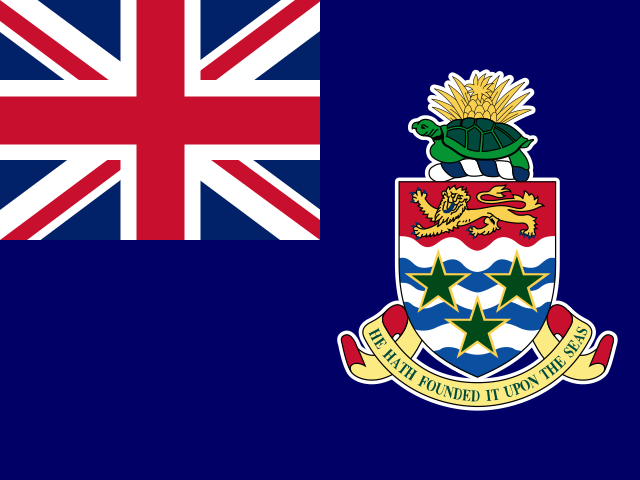 Cayman Islands company formation CAYMAN ISLANDS COMPANY REGISTRATION
 01 / BUSINESS GUIDE
 02 / BUSINESS GUIDE
 03 / BUSINESS GUIDE